
Rajat Masiwal

Postdoctoral Scholar · University of Chicago

July 850 hPa winds & rainfall, 1991–2020 means
NCEP/NCAR Reanalysis · GPCP · Natural Earth

July 850 hPa winds · the Somali jet Portrait of Rajat Masiwal

About me

I'm a postdoctoral scholar in the Department of the Geophysical Sciences at the University of Chicago and a member of the Climate Extremes Theory and Data (CeTD) group. Here I work on both decision-oriented evaluation of AI weather models for operational forecasting and process-based evaluation that tests whether they capture the underlying physics and generalize beyond their training data.

Previously, I did my PhD in tropical dynamics with Ashwin Seshadri at the Centre for Atmospheric and Oceanic Sciences (CAOS), Indian Institute of Science, working on the monsoon seasonal transition and intraseasonal variability.

My work combines theory, observations and a hierarchy of models, from idealized aquaplanets to AI emulators.

Research

AI weather models

Decision-oriented benchmarking of AI weather models

  • AI weather models now often beat physics-based models on standard metrics at a fraction of the computing cost, but they are judged on aggregate scores rather than on the decisions people face.
  • We introduce a decision-oriented benchmarking framework linking meteorology, AI and the social sciences, and apply it to a 150-year-old problem: forecasting Indian monsoon onset for rain-fed agriculture.
  • AI models predict onset skillfully weeks ahead. The framework informed a 2025 government effort that sent AI-based forecasts to 38 million farmers, which captured an unusual weeks-long pause in the monsoon.

Reference

Masiwal, R. et al. Decision-oriented benchmarking to transform AI weather forecast access: Application to the Indian monsoon. arXiv (2026). arXiv:2602.03767

Aitken, C., Masiwal, R. et al. Designing probabilistic AI monsoon forecasts to inform agricultural decision-making. arXiv (2026). arXiv:2603.07893
Boundary layer dynamics in monsoon flows

The advective boundary layer in cross-equatorial flow

  • The classic Ekman picture of the tropical boundary layer ignores nonlinear advection of momentum and breaks down near the equator, where Earth's rotation is weak.
  • At South Asian monsoon onset, the boundary layer switches to a new regime, the advective boundary layer, and a scaling analysis predicts when this transition occurs.
  • Aquaplanet experiments confirm the theory, establishing the advective boundary layer as a distinct regime with implications for monsoon onset, intraseasonal variability and climate models.

Reference

Masiwal, R., Seshadri, A. K. & Dixit, V. Emergence of an advective boundary layer in monsoon cross-equatorial flow: Scaling, dynamics, and idealized models. J. Atmos. Sci., early online release (2026). doi:10.1175/JAS-D-26-0028.1 · Code · Data

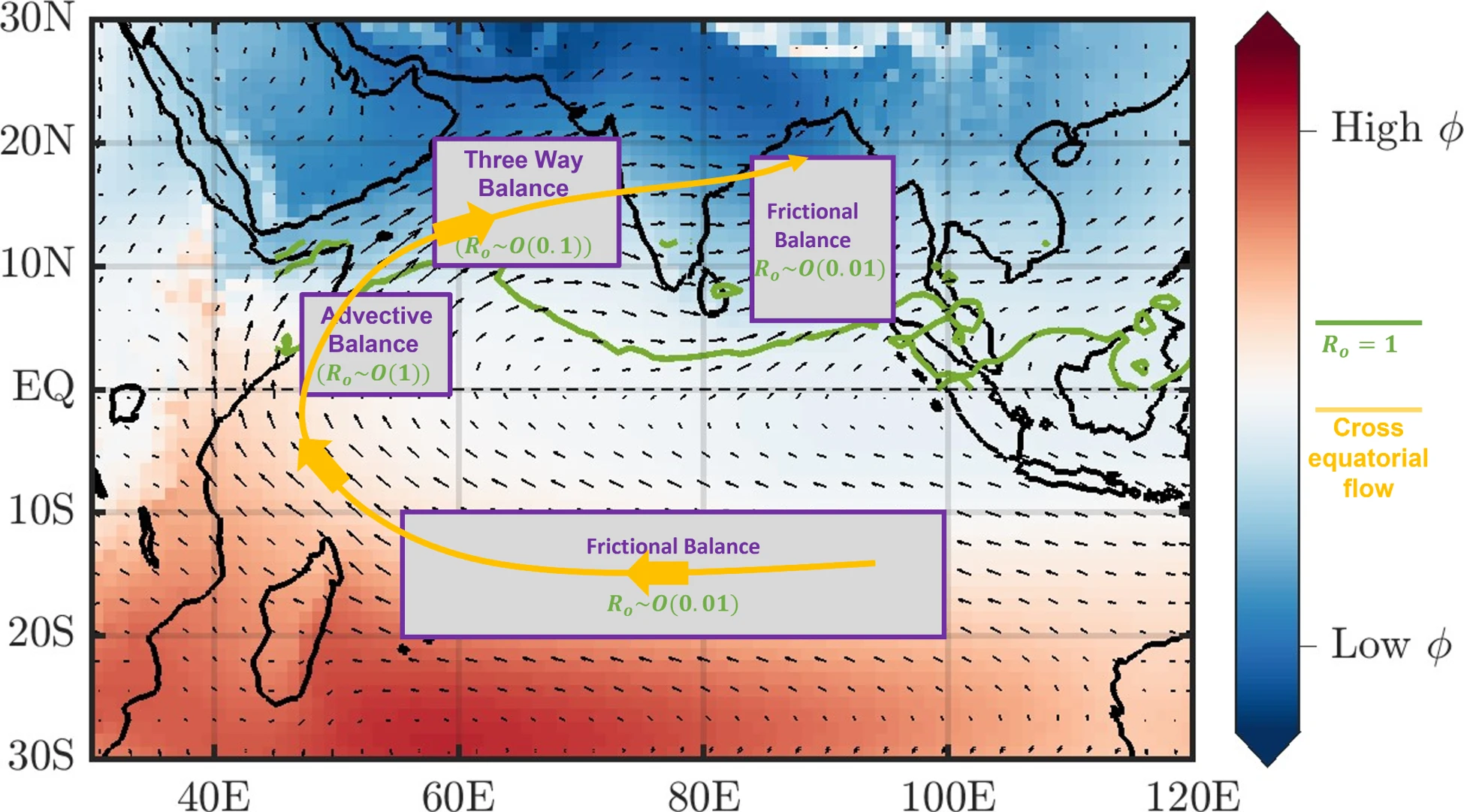
Map of geopotential and winds over the Indian Ocean with boxes marking frictional, advective and three-way boundary-layer kinetic-energy balances along the cross-equatorial flow

Rapid onset of the Somali jet

  • The low-level Somali jet is the main moisture pathway for the South Asian monsoon and, like the monsoon, sets in rapidly and retreats slowly.
  • Its kinetic-energy budget changes regime along the flow: frictional south of the equator, advective near it, and a three-way balance in the mature jet.
  • In the advective regime, energy generation grows quadratically with the north–south pressure gradient, which explains the jet's rapid onset and slower retreat.

Reference

Masiwal, R., Dixit, V. & Seshadri, A. K. Explaining dynamics and rapid onset of the Somali jet through its kinetic energy budget. J. Atmos. Sci. 80, 833–847 (2023). doi:10.1175/JAS-D-22-0160.1

Intraseasonal variability in the tropics

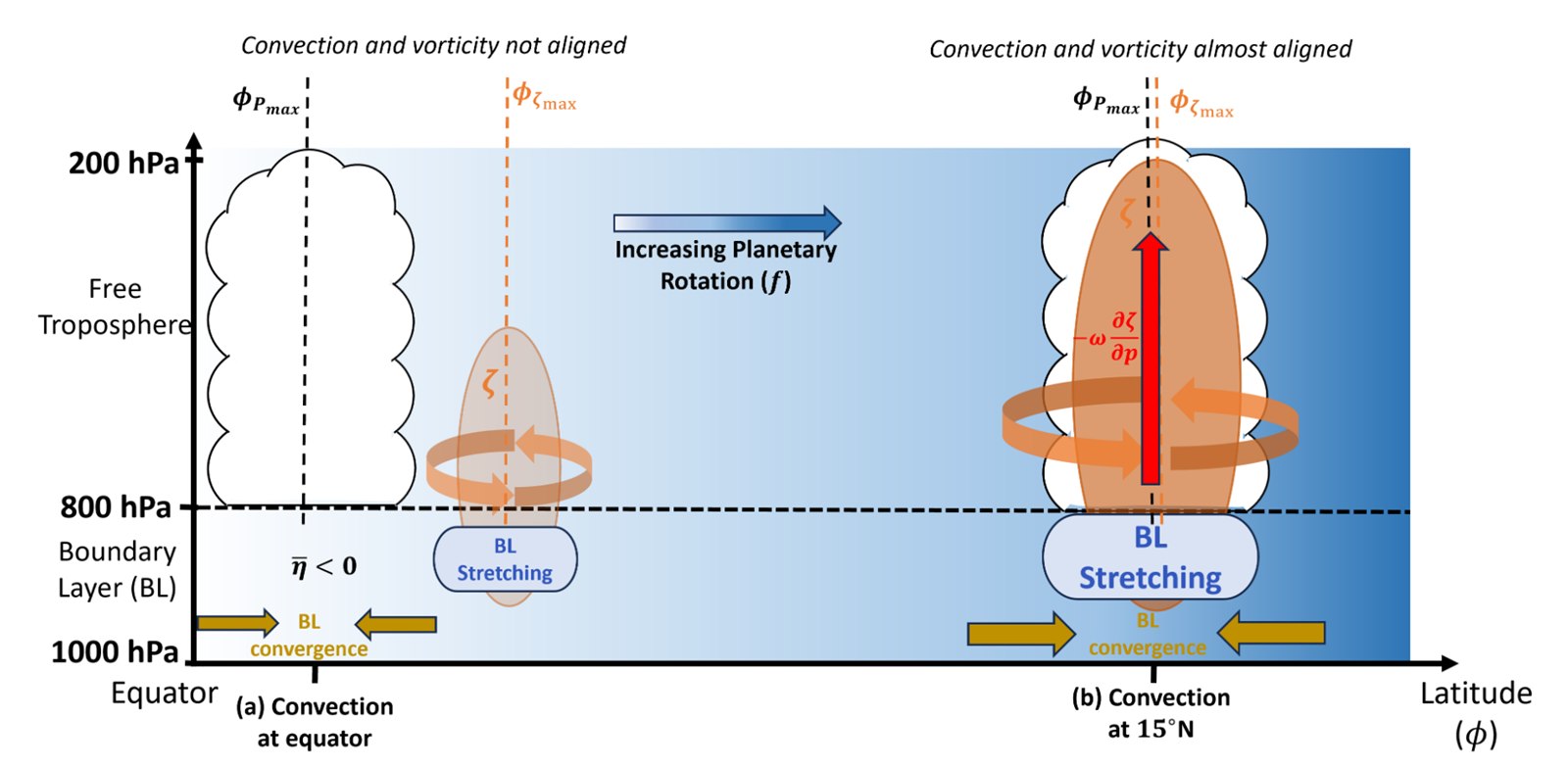
Schematic of the vertical structure of vorticity for convection at the equator and at 15 degrees north

Convection–circulation coupling across the tropics

  • Convection and circulation are tightly coupled in the tropics, and the coupling shows up in vorticity, which both aids and is shaped by convection.
  • Across tropical ocean basins and intraseasonal timescales, rainfall and vorticity are only loosely linked near the equator but line up in space and time farther from it, where stronger rotation enhances boundary-layer vortex stretching.
  • This systematic pattern offers a benchmark for testing how climate models link rainfall and circulation.

Reference

Masiwal, R., Dixit, V. & Seshadri, A. K. Intraseasonal convection–circulation coupling in the Northern Hemisphere tropics: A vorticity-budget analysis. Q. J. R. Meteorol. Soc. (2025). doi:10.1002/qj.4969

Animation of composite anomalies and winds over the Indian monsoon region from day −20 to day +20, with bands moving north from the equator

Contrasting controls on monsoon convection

  • Understanding what controls convection is key to better monsoon rainfall forecasts.
  • For the northward-moving intraseasonal oscillations of the Indian summer monsoon, the control depends on latitude: near the equator the circulation leads rainfall, while over central India a moistening boundary layer leads and the circulation follows.
  • The same moisture-led control precedes large-scale extreme rainfall over central India, and characterizing these controls can help reduce climate-model biases in monsoon rainfall.

Reference

Masiwal, R., Dixit, V. & Seshadri, A. K. Contrasting controls on convection at latitude zones near and away from the equator for the Indian summer monsoon. Environ. Res. Lett. 18, 114027 (2023). doi:10.1088/1748-9326/ad0164

Publications

  1. Decision-oriented benchmarking to transform AI weather forecast access: Application to the Indian monsoon

    R. Masiwal, C. Aitken, A. Marchakitus, M. Gupta, K. Kowal, H. A. Pahlavan, T. Yang, Y. Q. Sun, M. Kremer, A. Jina, W. R. Boos, P. Hassanzadeh

    arXiv preprint · 2026 · PDF

  2. Emergence of an advective boundary layer in monsoon cross-equatorial flow: Scaling, dynamics, and idealized models

    R. Masiwal, A. K. Seshadri, V. Dixit

    Journal of the Atmospheric Sciences (early online release) · 2026 · Code · Data

  3. Designing probabilistic AI monsoon forecasts to inform agricultural decision-making

    C. Aitken, R. Masiwal, A. Marchakitus, K. Kowal, M. Gupta, T. Yang, A. Jina, P. Hassanzadeh, W. R. Boos, M. Kremer

    arXiv preprint · 2026 · PDF

  4. Intraseasonal convection–circulation coupling in the Northern Hemisphere tropics: A vorticity-budget analysis

    R. Masiwal, V. Dixit, A. K. Seshadri

    Quarterly Journal of the Royal Meteorological Society · 2025

  5. Contrasting controls on convection at latitude zones near and away from the equator for the Indian summer monsoon

    R. Masiwal, V. Dixit, A. K. Seshadri

    Environmental Research Letters 18(11), 114027 · 2023 · PDF (open access)

  6. Explaining dynamics and rapid onset of the Somali jet through its kinetic energy budget

    R. Masiwal, V. Dixit, A. K. Seshadri

    Journal of the Atmospheric Sciences 80(3), 833–847 · 2023

  7. Investigating controls on intraseasonal convection and the abrupt seasonal transition in the boundary layer during monsoons

    R. Masiwal

    Ph.D. thesis, Indian Institute of Science · 2025